
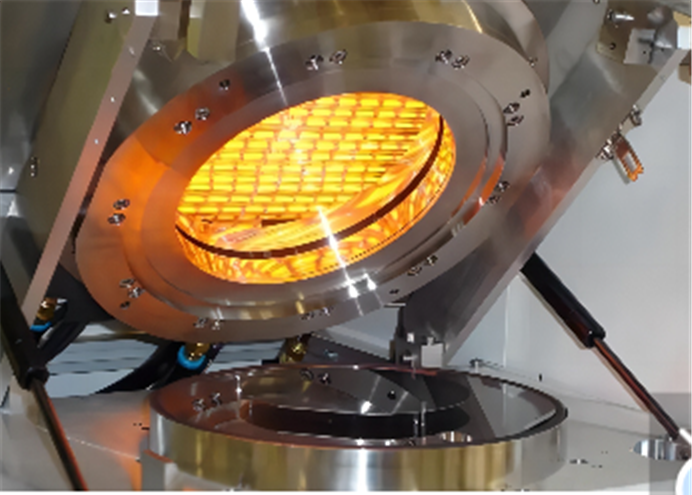
On the lithography floor, soft bake and hard bake aren’t just about drying photoresist. They set the thermal budget that decides your linewidth control, sidewall profile, and how smoothly the wafer flows through the rest of the line. When the IR lamp isn’t performing—hot spots in one spot, cold spots in another—you don’t just lose one lot. You get scrap, rework, and a slow bleed of process margin. We built our quartz sleeve for fab IR lamps to cut that variability off at the source: right where the lamp meets the process chamber, where heat, cleanliness, and repeatability all collide.
What matters, technically
In a fab, an IR lamp is more than a heat source. It’s a calibrated thermal actuator. The quartz sleeve around it has to preserve the lamp’s intended output while staying inert in a Class 1–100 cleanroom. We use high-purity quartz chosen for stable transmission in the near-infrared (NIR) band used by halogen and short-wave IR lamps. The sleeve is engineered to keep heat distribution consistent across the wafer plane, supporting wafer-level temperature uniformity within tight tolerances—typically ±0.1°C in production bake profiles. That’s not a marketing figure. It’s the difference between a CD that tracks the design and one that drifts every time the batch changes. The sleeve geometry matches standard lamp envelopes and mounting hardware, so the lamp’s output couples predictably into the chamber. No unintended reflections. No localized overheating. Just repeatable thermal coupling. Thermal cycling doesn’t stop. Quartz handles it without the fatigue behavior you see in some ceramics. It also runs cooler at the surface than metal fixtures, which reduces local convection and keeps particle generation low. Cleanroom compatibility is non-negotiable. The surface finish and material purity are selected to hold particle counts down. Zero particle generation is the target, because one particle on the sleeve can become a resist defect.
Why this works in practice
Photoresist processing is where temperature uniformity turns into yield. During soft bake, solvent removal has to be uniform across the wafer. If the center runs hotter and the edge cooler, the resist cures unevenly. You’ll see that later as dimensional errors and footing. During hard bake, the same nonuniformity can drive flow, skin formation, and poor adhesion—often visible as scumming at pattern edges. Our quartz sleeve keeps the bake profile consistent lot after lot. That repeatability reduces the need to tweak recipes when lamps age, when chamber conditions drift, or when the line switches products. It also shields the lamp from process byproducts and cleaning chemistries, so output stays stable over time. We’ve seen units run 5,000+ hours with less than 5% output drop, depending on lamp type and duty cycle. That means fewer lamp swaps, fewer PMs, and fewer chances for process excursions. Energy use isn’t an afterthought. The sleeve helps direct heat where it’s needed and cuts waste heat that drives HVAC load in the cleanroom. In a 24/7 fab, small efficiency gains add up fast. The practical wins are straightforward:
- Tighter critical dimension control in lithography.
- Fewer bake-related defects that trigger rework and scrap.
- Less downtime tied to lamp and hardware changes.
- Lower cleanroom thermal load, which can reduce cooling costs. This isn’t about chasing one spec in isolation. It’s about holding temperature, cleanliness, and repeatability together, because yield depends on all three.
The details that bite you
A quartz sleeve isn’t a universal part. It has to match the lamp envelope, the socket, and the chamber geometry. Too tight, and you risk stress and uneven thermal contact. Too loose, and air gaps shift the profile and invite particulates. Installation needs discipline. Use cleanroom-compatible tools and gloves. Inspect the sleeve for chips or scratches before mounting. A damaged edge can shed particles, and a scratch can create a local hot spot. Thermal shock is real. Bring the sleeve up with controlled ramps. Rapid cycling can induce microcracks, shortening life and hurting uniformity. Compatibility depends on the bake tool. Some chambers use quartz boats or fixtures that must align with the sleeve dimensions. Confirm fit with the tool’s OEM or with measured drawings before you buy. And cleaning matters. Stick to recommended chemistries and methods. Aggressive cleaning can etch the quartz surface, changing transmission and increasing particle shedding. If you’re running lithography bake steps and you want photoresist to stop reacting to hardware variability, the sleeve is one of the most direct ways to get there. It’s a small component, but in semiconductor manufacturing, the smallest part often carries the biggest thermal and cleanliness risk. Treat it that way, and it pays you back in stable yield.